

Ways of Coping
Not every coping skill will speak to every part of you and that’s okay.
Take what resonates, leave what doesn’t.
Different parts need different kinds of care at different times.
This is a collection of skills I’ve gathered from lived experience, with the hope of making things feel a little more manageable.
You’re human, and getting through things can be hard. If you’re here looking for ways to cope, I see how much effort that takes and that matters.
-
Draw/paint/colour by number
-
Take a nap/go to bed
-
Listen to music
-
Clean or organise a space
-
Play a computer/phone game
-
Read a book
-
Listen to podcasts
-
Count backwards from 500
-
Category game (a word for each letter A-Z)
-
Watch funny videos on YouTube
-
Make a list of things that make you happy
-
Do something nice for someone else
-
Watch TV
-
Mindful eating/walking/writing
-
Pick a subject and research it
-
Chose an object and write a detailed description of it
-
Go for a walk
-
Sing or play an instrument
-
Paint your nails
-
Bake/cook something
-
Dance to music
-
Scroll Pinterest/Substack
-
Create a coping skills toolbox
-
Wash your hair
-
Blow bubbles
-
Play solitaire
-
Tidy a room or sort something
-
Make a blanket fort
-
Grab a snack
-
Check out Recovery Ideas for more distractions
General Ideas
Sometimes in the moment it can be hard to think of ways to cope with pain or big emotions. These are some simple ideas grouped by different 'needs' you may need met when you are going through hard moments.
Not everything in here will work for you but if one idea can help even a little bit, then this list will have done it's job :)
Harm Minimisation
Resisting self-harm can be fucking hard. I see that. Sometimes it feels impossible, and that’s not a sign of weakness; it’s a sign of how much pain you’ve been carrying. This list isn’t meant to fix everything or tell you what to do. It’s just a collection of things that might help you make it through a wave, a night, or even just the next ten minutes.
Some of these might help, some might not and that’s okay. Take what feels right, leave what doesn’t. There’s no one-size-fits-all when it comes to surviving. What matters most is that you keep trying, keep breathing, and keep holding on, even when it feels pointless. You deserve safety, support, and gentleness — even on the days you don’t believe that.
If even one of these ideas helps you stay safe for a little while longer, that’s a win. You don’t have to get it perfect just keep holding on.
TLDR - What You’ll Find Here
-
It’s fucking hard to resist self-harm — I see you, and you’re not alone in that.
-
This list won’t fix everything, but some things might help — even just for 10 minutes.
-
Take what helps, leave what doesn’t. Keep holding on; every small moment of safety matters.
Types of Harm Minimisation Strategies
Harm minimisation looks different for everyone. It’s about finding safer ways to cope, release, express, or ground yourself when the urge to self-harm feels overwhelming. There’s no right or wrong way to do that — just what helps you get through.
Here are the main types of strategies people often find helpful:
-
🧊 Sensory Alternatives:
Physical sensations that safely mimic the intensity or grounding feeling of self-harm — like holding ice, snapping an elastic band, or taking a cold shower.
-
🖋 Emotional Release / Expression:
Ways to get strong emotions out without hurting your body — like journalling, drawing, screaming into a pillow, or creating art that matches how you feel.
-
🌬 Grounding & Soothing:
Calming your nervous system when things feel too big — through breathing exercises, mindfulness, warm blankets, or slow stretches.
-
🤝 Connection & Support:
Reaching out — to a friend, helpline, online community, or even just sitting near someone. You don’t have to explain everything to be worthy of support.
-
🎧 Distraction & Redirection:
Shifting your focus until the urge passes — by watching a show, playing a game, cleaning, or doing something with your hands.
-
💪 Safety Planning & Environment:
Making small choices that help you stay safe — like delaying the urge, removing easy access to harmful tools, or keeping emergency numbers close.
TLDR
-
Harm minimisation is about finding safer ways to cope when the urge to self-harm hits.
-
Strategies can help you release, ground, distract, or connect without causing harm.
-
There’s no one right way — take what helps, leave what doesn’t.
DBT Skills
These tools draw largely from Dialectical Behaviour Therapy (DBT), a skills-based therapy that teaches practical ways to navigate intense emotions, distress, and relationships. The skills are organised into sections so you can find the kind of support that fits what you’re experiencing right now.
You might approach these tools with curiosity and gentleness. Different moments, and different parts of you, may need different kinds of support. This space is here to offer options, care, and guidance when things feel hard.


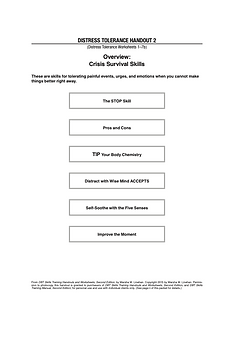
Crisis Survival DBT Handouts
Handouts to help you practice the crisis skills, act as simple reminders and give you options on how to use each skill. Not every skill will work for you and that is ok.


Distress Tolerance Skills - Crisis Survival
When crisis skills can help: Crisis skills are designed for moments when things feel really intense and overwhelming. They’re not about fixing everything — they’re about helping you get through the moment safely until the intensity settles.
_tiff.png)
_tiff.png)
_tiff.png)
Distress Tolerance Skills - Reality Acceptance
What are reality acceptance skills? Radical acceptance is gently acknowledging what’s real, right now, with your mind, body, and heart. It’s about easing the fight with reality so you’re not carrying extra pain on top of what’s already there — without giving up or saying it’s okay.


This corner of the site is still under construction, but it's being built with compassion and connection! Our focus is on making it a truly valuable resource. You’re invited to explore what’s here so far, take what resonates, and leave what doesn’t. More content will be added over time, and feedback is always welcome as this space grows.